

In this week's edition of The Pointillist, a splattering of links and analysis on the ongoing fallout from the Iran–Israel–US conflict, plus its implications for energy and geopolitical transitions in Aotearoa New Zealand and elsewhere.
The Middle East crisis drags on... Iran has lost lives and infrastructure, but gained leverage over the Strait of Hormuz that it did not possess before the Israel-US offensive. This is helping the Islamic Revolutionary Guard Corps (IRGC) to reconsolidate its political power. As the underdog in this confrontation, victory for the IRGC could be defined simply as 'not losing'. By surviving the combined assault from a global superpower and regional hegemon – and even by securing some benefits – the IRGC is cornering the US and Israel into one or other kind of strategic defeat, falling far short of their original objectives. To be sure, the IRGC remains vulnerable on domestic matters, tainted by its legacy of economic mismanagement and cruelty. But its persistence under fire is further destabilizing Western presumptions about the nature of the global order.
My friend Eskandar Sadeghi-Boroujerdi has contributed some excellent writing on this subject, complemented by his deep knowledge of Iranian history and politics:
The US-Israeli campaign has inflicted immense damage on Iran’s industrial base and imposed severe costs on its middle and popular classes, degrading long-term prospects for national development. But it has not produced the rapid political capitulation that such forms of pressure are often presumed to deliver. Instead, it has exposed the limits of coercive escalation in a context structured by interdependence. Even as imperial power continues to operate through destruction and domination, it has struggled to translate overwhelming force into decisive political outcomes, generating a more unstable and contested equilibrium than its architects anticipated. The broader architecture of dollar-based coercion faces a related if distinct set of limits. The very intensity of financial sanctions has incentivized targeted states to construct alternative circuits of exchange, gradually eroding the structural leverage on which weaponized interdependence depends. Iran’s control of the Strait of Hormuz during Operation Epic Fury offers an unusually powerful illustration of this dynamic: the same interdependence that made financial isolation so effective has also created physical and economic vulnerabilities that a sufficiently determined adversary can exploit. Re-imperialization, it turns out, comes with its own contradictions.
 Eskandar Sadeghi-Boroujerdi
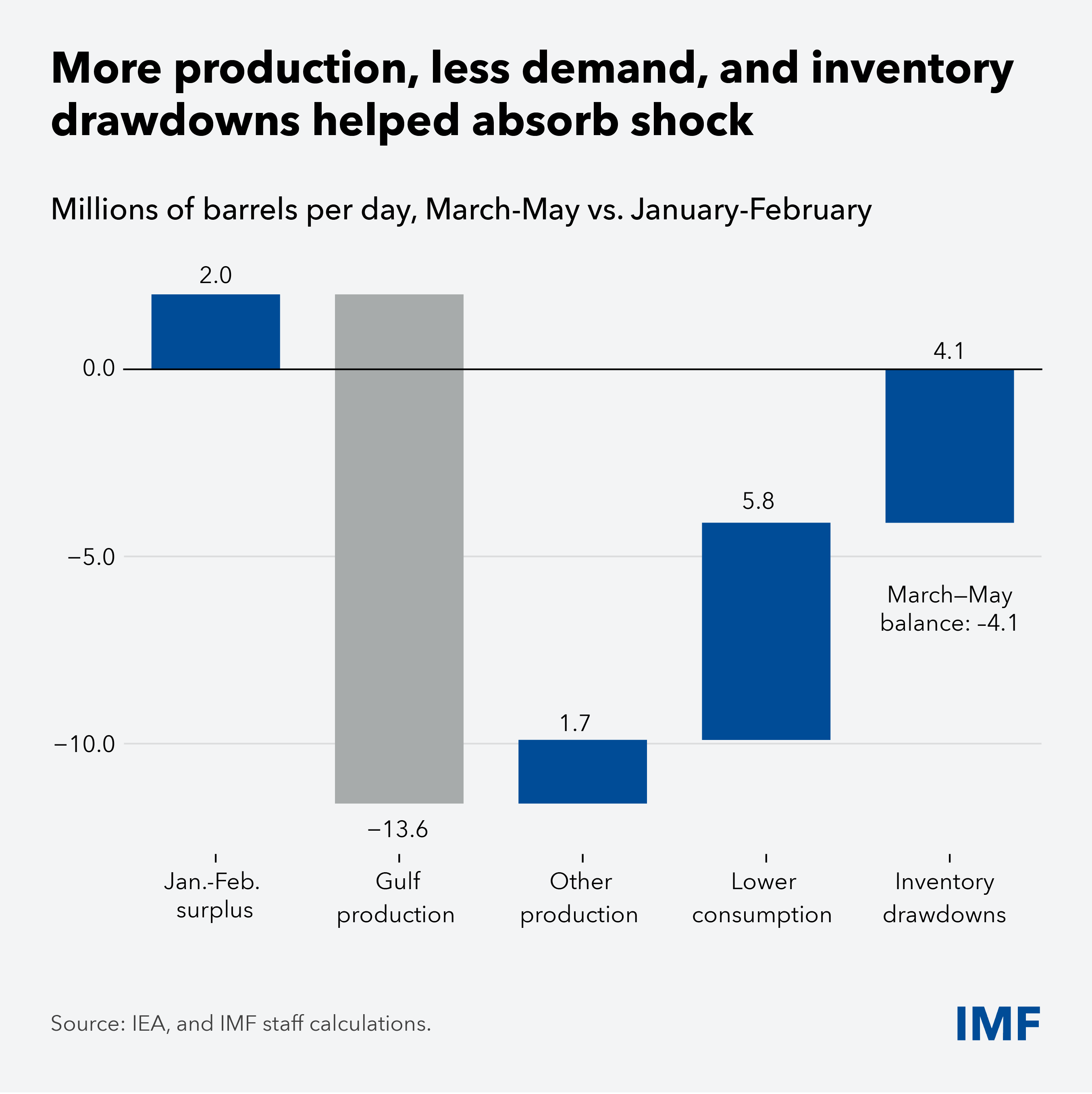
The worst-case scenarios for the global economy have not yet eventuated. Global oil stockpiles, demand reductions, and additional production spared the world from an abrupt energy crunch by closing a gap of over one billion barrels in lost oil supply (see the IMF chart below).
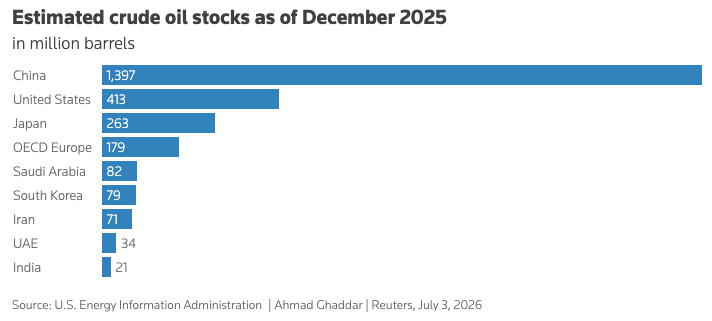
China, especially, played a critical role in buffering the effects of the US's colossal misadventure. Its pre-war stocks were prodigious (see the chart below), complemented by its ability to dial down oil imports: its June deliveries were 41% lower than the previous year's.
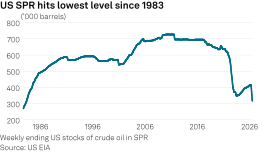
Meanwhile, it is no coincidence that President Trump angled for a ceasefire when he did: TACO (Trump Always Chickens Out) reasserted itself as reserves ran low: US strategic oil reserve is at its lowest level since 1983 (see chart below). Globally, these drawdowns leave the fossil energy system in a precarious state, and significantly raise the stakes for any continuation of hostilities. This puts pressure on Trump to take the L, even if he dresses it up as a V.
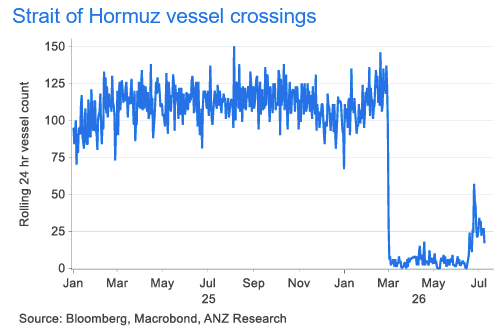
If not a crippling supply shock, a long tail of elevated prices seems likely. At the time of writing, maritime traffic in the Strait of Hormuz is still highly constrained (see below). Oil traders need to recover their costs (this interview with Z Energy CE Lindis Jones is instructive). And countries need to invest in the replenishment – and potentially the expansion of – strategic reserves.
The International Energy Agency (IEA) states in its most recent oil market report:
Despite the significant reductions in demand for crude oil and refined products, the buffers in the system continue to erode at a record pace. Global observed oil stocks have declined by 3.8 [million barrels per day] on average since the start of the war... Further declines in the coming months could still take global oil stocks to historic lows before the market balance shifts to surplus towards the end of the year.
The Reserve Bank of New Zealand (RBNZ) is still expecting a brief bump in inflation – 3.3% in the current quarter, 3.9% in the June quarter – rather than a major inflationary event. However, Chief Economist Paul Conway did observe in his speech yesterday that last week's events add 'upside risks' to forecasts.
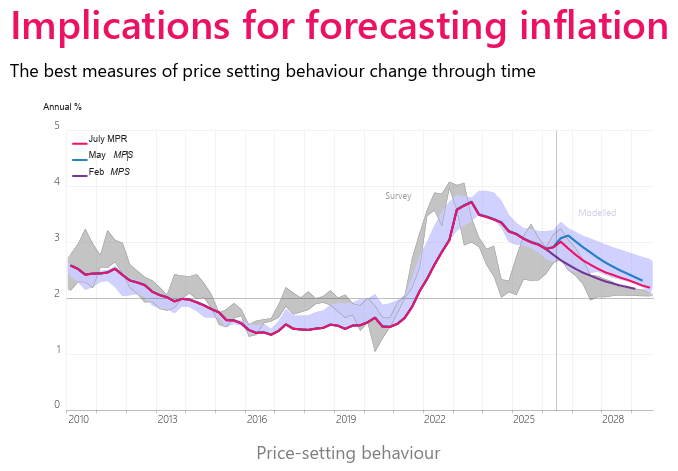
This observation also caught my attention:
New Zealand businesses have also become more likely to increase prices when costs increase, and less likely to cut them when costs fall. That is, price-setting has become more asymmetric, with firms quicker to pass through rising costs than to reverse price increases as inflation recedes. This pattern is most evident among firms in the services sector, which is an increasingly large share of the New Zealand economy.
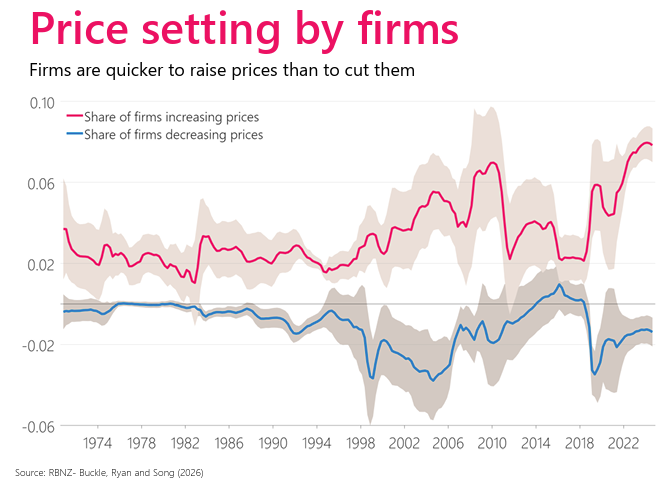
This raises the spectre of sellers' inflation (also known as profit-led or greed flation), a controversial concept which contends that businesses may exploit moments of macroeconomic distress – such as energy crises – to raise prices excessively, or to sustain prices at elevated levels even after the shock has abated. Whether this eventuates will be something that the greedflation hawks will be carefully watching.
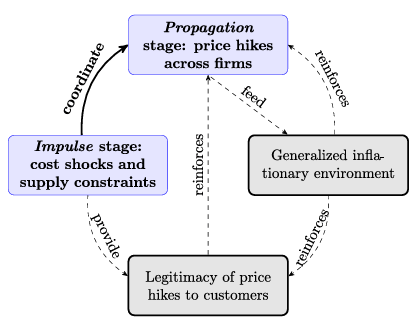
As such, the incentives to transition away from fossil fuel dependency are likely to persist.
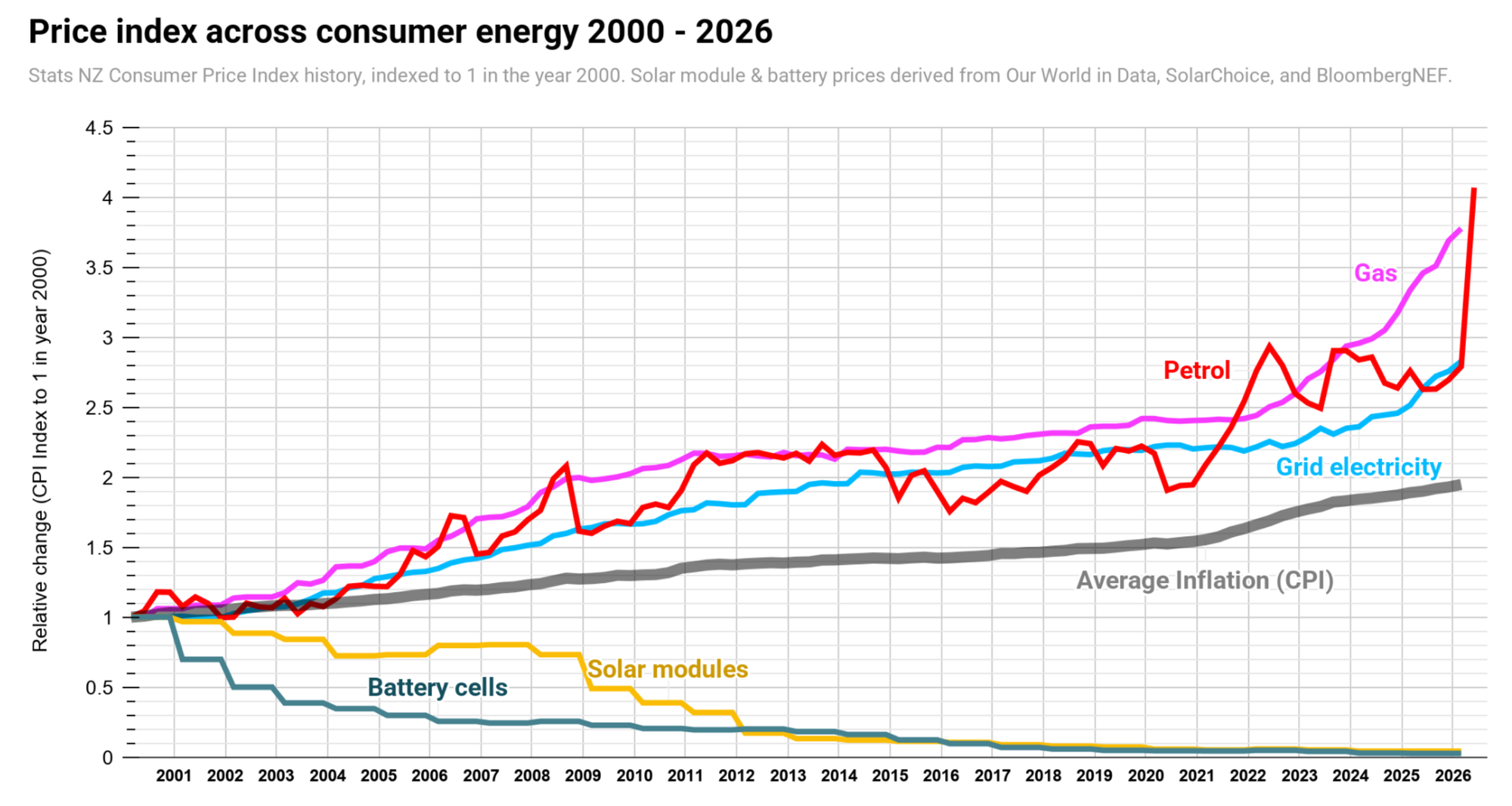
Simultaneously, as Rewiring Aotearoa shows in its new report, the economics for solar modules and batteries continue to improve, relative to conventional energy infrastructure of gas, petrol and grid electricity (see the chart below).
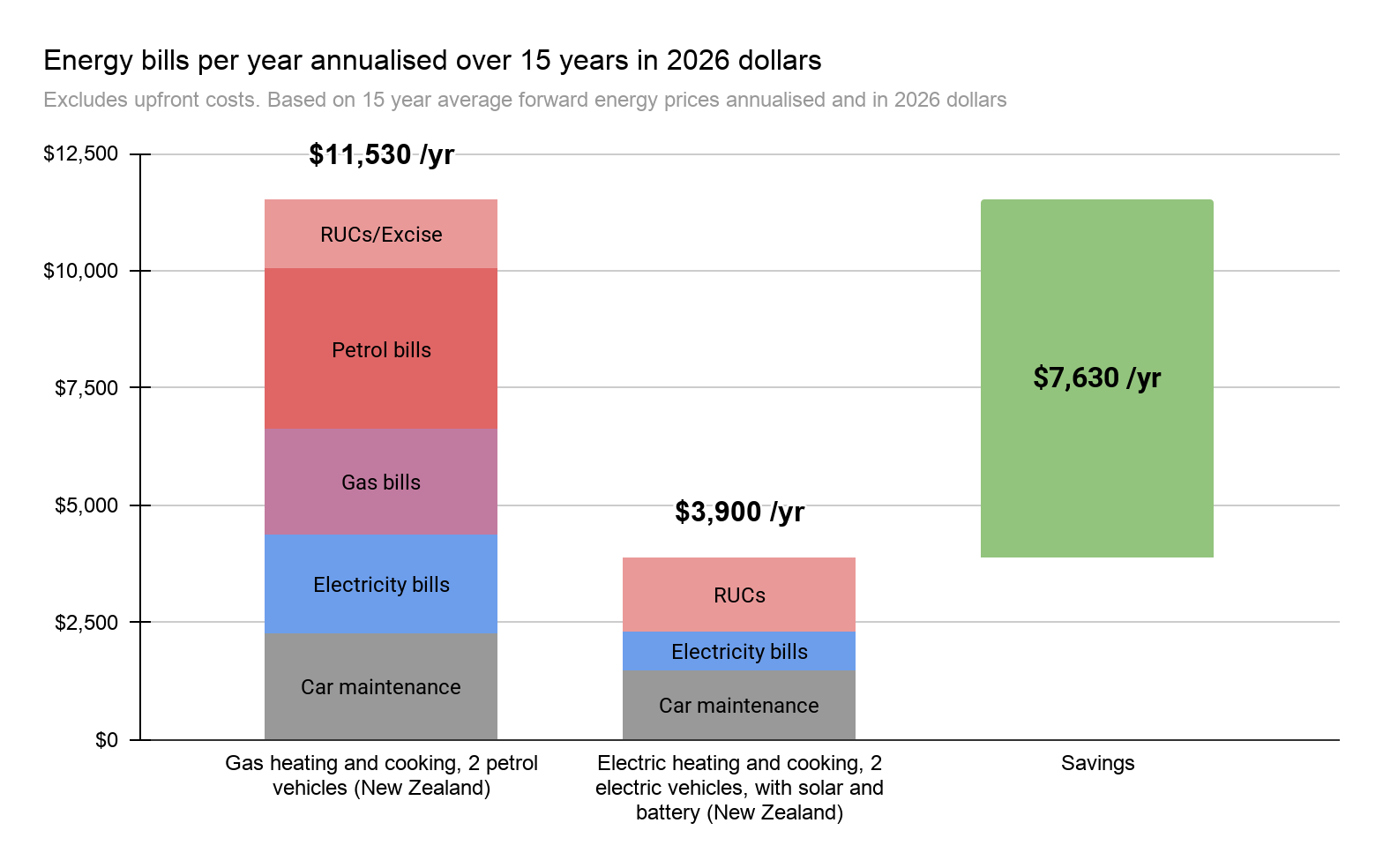
Energy-related bills are substantially reduced for households (see the chart below) if they embrace the twin transitions from fossil fuels to electricity, and from less to more distributed generation (i.e. from grid electricity to self-generated solar electricity).
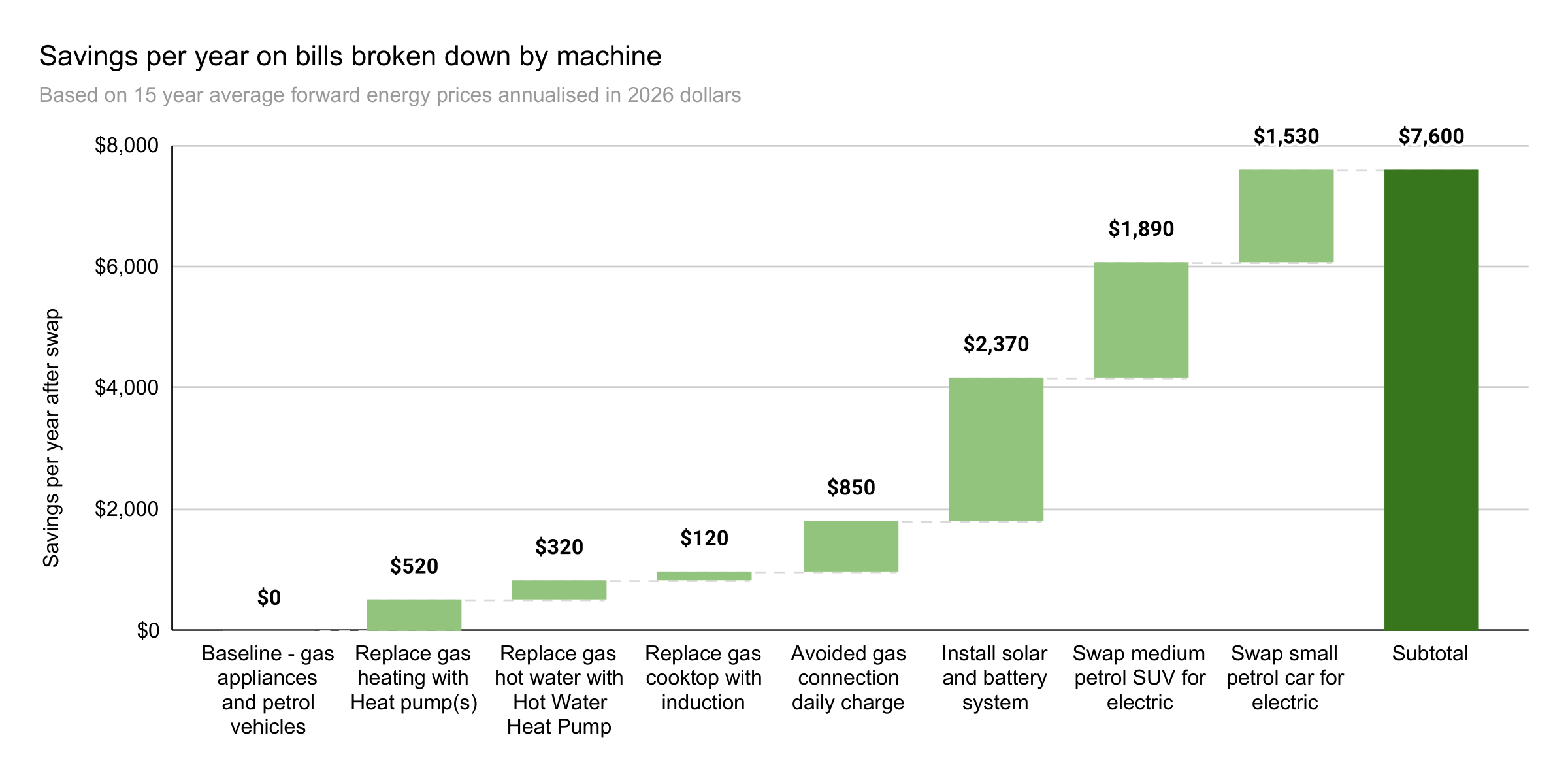
Those savings are spread across the obsolescence of many fossil-fuelled appliances and machines that were once an unquestioned feature of the ordinary household (see the chart below).
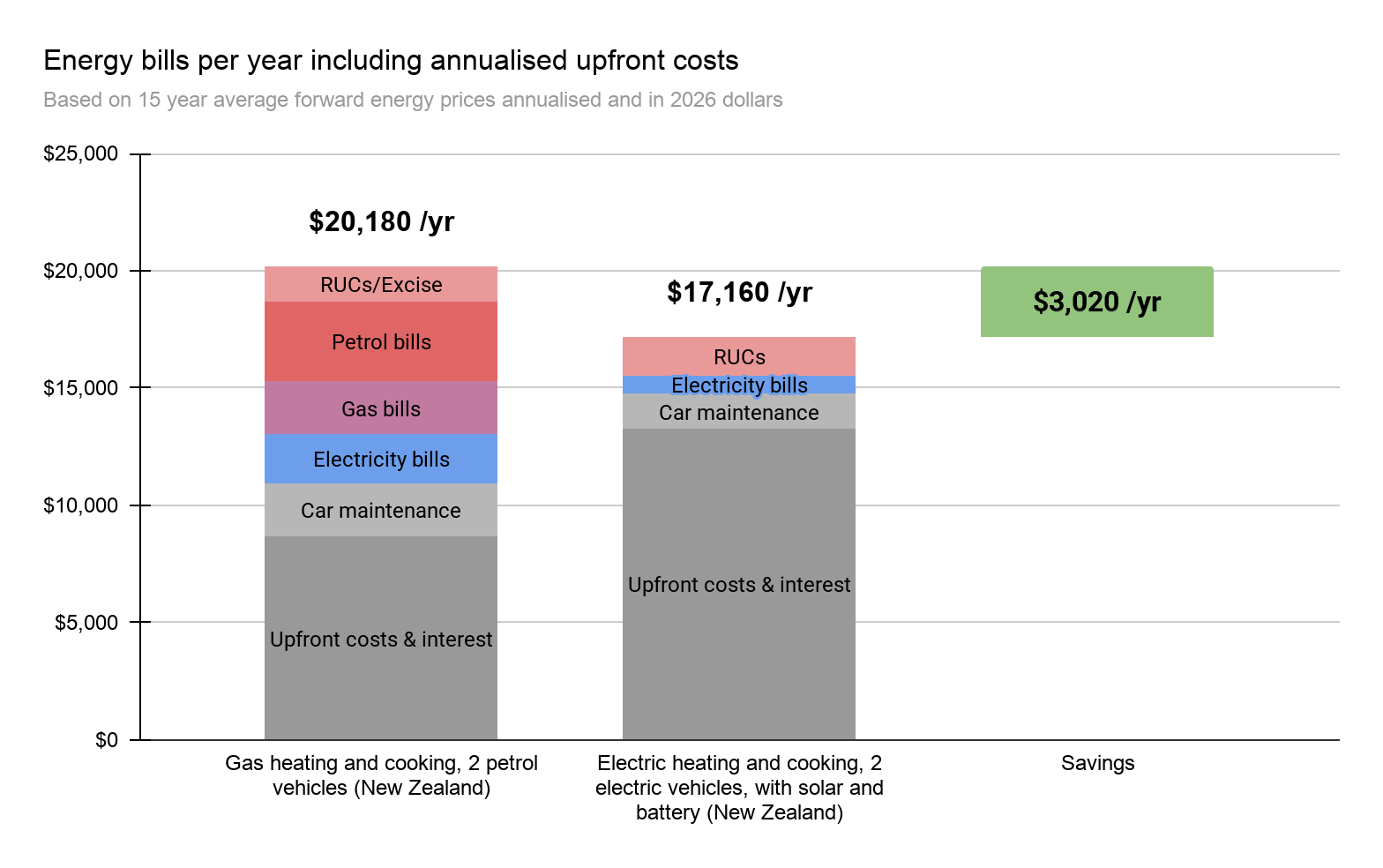
The major challenge remains the upfront costs of new kit. These costs are declining, but still pose a considerable barrier to many households who are contemplating a leap into the electrified unknown (see the higher upfront costs in dark grey below).
So Rewiring Aotearoa, LGNZ and others scored a major win when the two big centre parties announced support schemes – the National Party with its Home Energy Fund, the Labour Party with SolarSaver – which were inspired by the Ratepayer Assistance Scheme that those groups have advocated for. In essence, these schemes enable property owners to access concessional debt, secured against the property rather than the individual, for financing rooftop solar and batteries, heat pumps, insulation, efficient electric appliances, and other approved energy resilience upgrades.
Despite the uncertainties in global fossil supply, the New Zealand Government is pushing ahead with its LNG import terminal. The unpopular levy on electricity users was dropped, although the 'fair funding model' being explored with the gentailers may yet sheet infrastructure costs back to consumers.
 James Mayger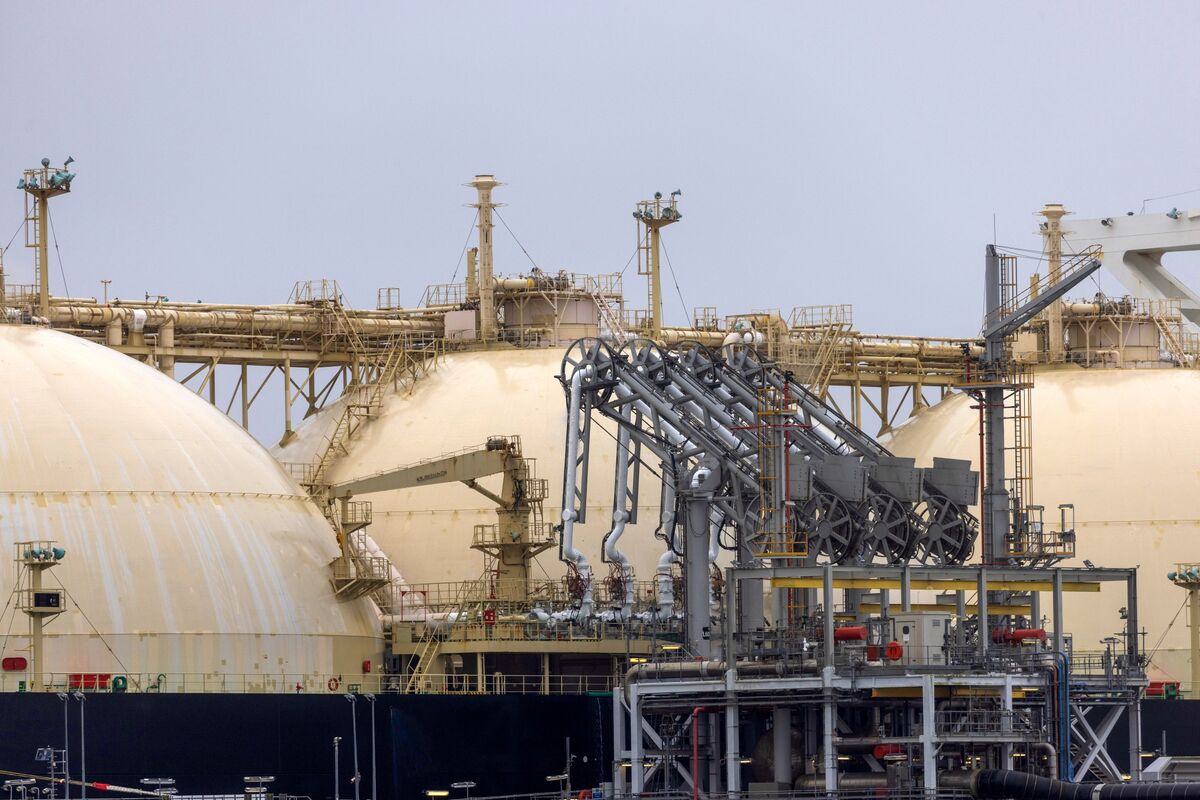
Meanwhile, it is ever less clear that the additional capacity from LNG is not necessary. Official analysis, released by OIA, advised that: 'Modelled need for LNG is low, even in scenarios with less other security resources' (see the RNZ story below). We seem to be taking on a lot of risks and costs for not much advantage.
This is reinforced by a new Sapere analysis which concludes that:
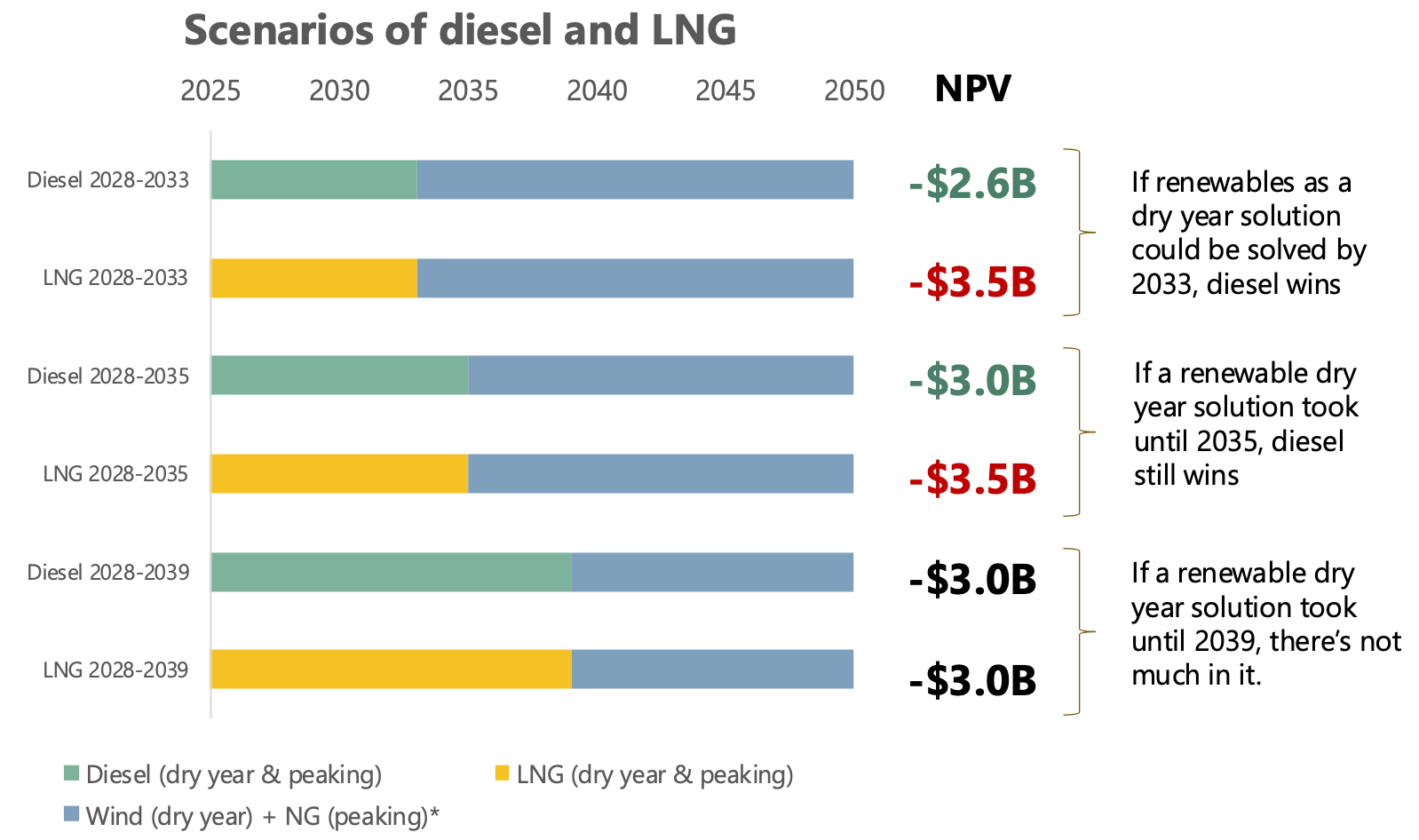
LNG appears premature and costlier than short-term diesel-based
bridging and long-term renewable options.
If the challenge is to bridge the gap until renewables can be firmed – for instance, by pumped hydro, renewables build-out or some other solution –, then diesel is likely the cheaper bridging option, especially if the long-term firming solution is delivered by the early 2030s.
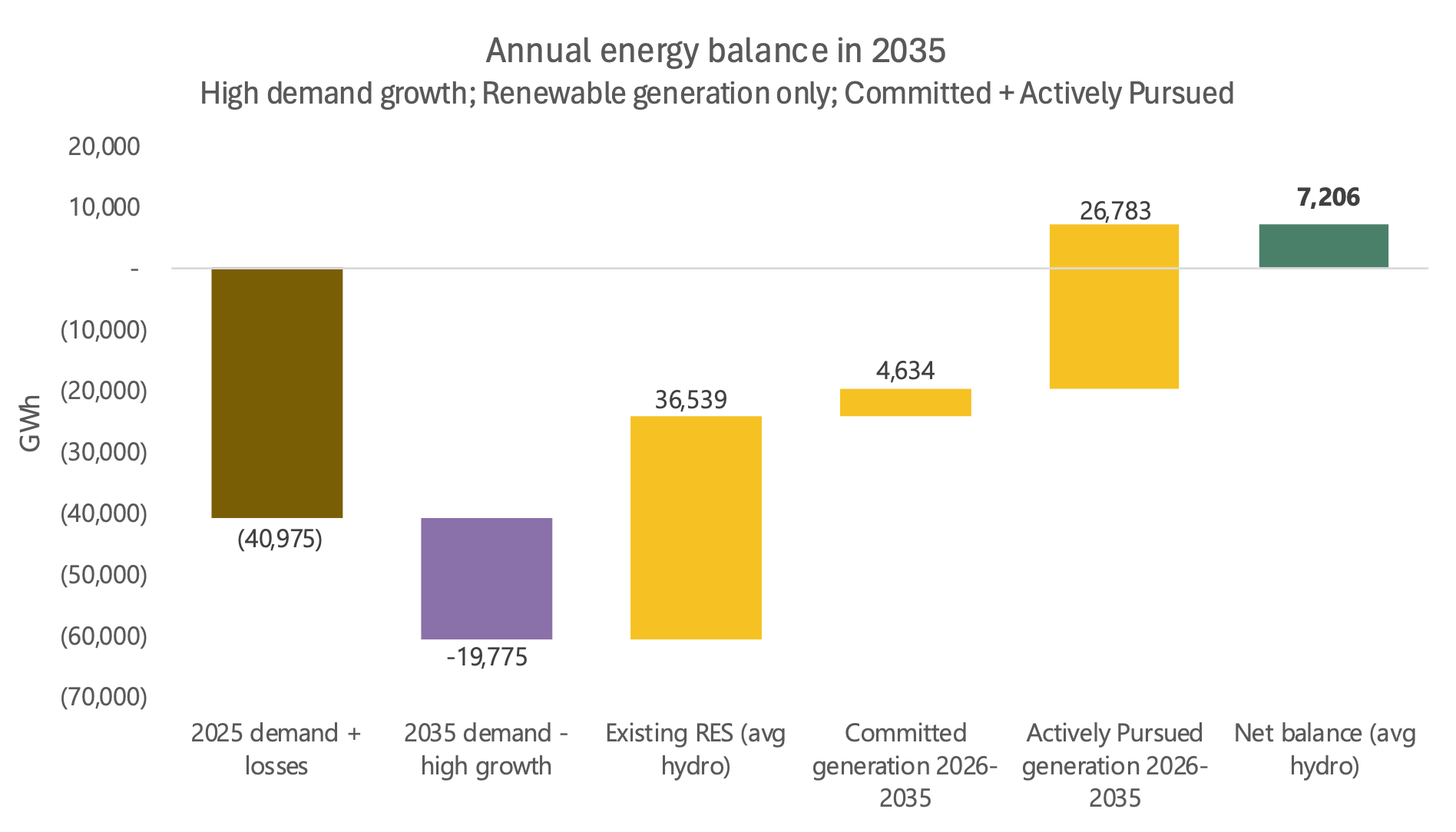
The chart below draws on Electricity Authority data to show that current energy demand (in brown) and potential future demand (in purple) could be met over the next 10 years (in yellow) by existing renewable generation, plus planned new infrastructure which is either 'committed' (final investment decision made) or 'actively pursued' (well advanced but no final decision yet).
This raises the peculiar spectre of a right-leaning government that wields state power to ram through energy infrastructure that risks crowding out private investment and increases the overall costs of the energy system. But here we are!
The case for renewables is not only supported by modelling and forecasting, but also by observation of how other countries are transitioning.
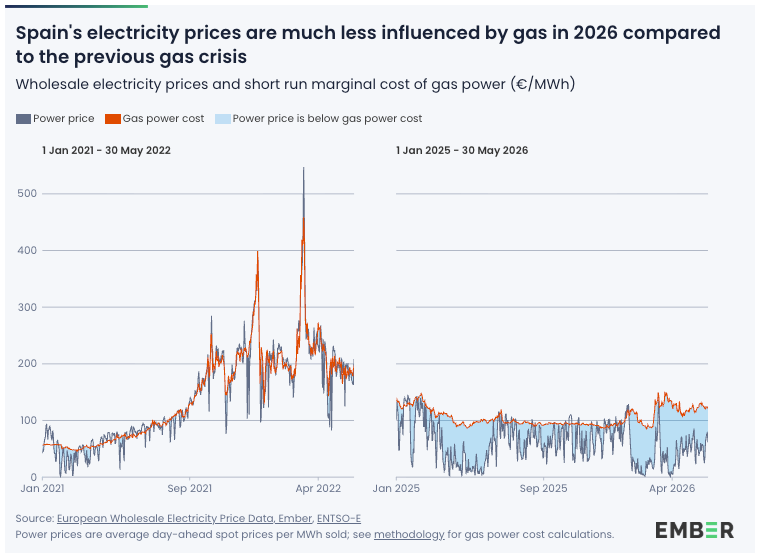
As this Ember analysis shows, Spain has gone hard on renewables in recent years, especially after the fossil price shocks of 2021–2022. Then, wholesale electricity costs were tightly linked to price spikes in fossil gas (see the leftward chart below). By the time the US-Israel-Iran conflict kicked off in 2026, electricity prices had already decoupled from gas prices (see the rightward chart below), thanks to a 37% increase in wind and solar between 2021 and 2025.
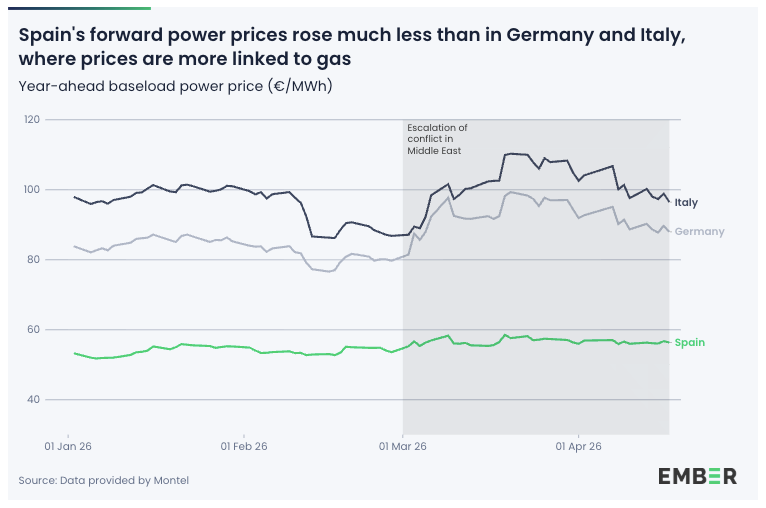
Spain now has much cheaper and less volatile power prices than countries like Germany and Italy, which still rely significantly on gas (see the chart below).
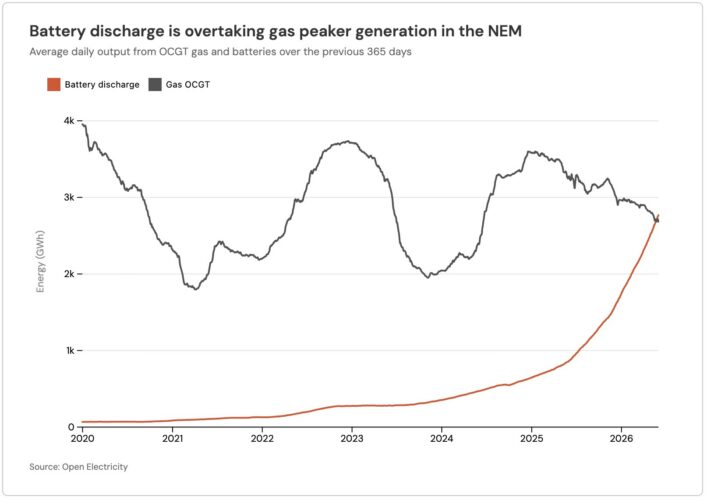
Meanwhile, in Australia, energy discharged from utility batteries onto the NEM, Australia's main electricity grid, now exceeds generation from peaking gas turbines (see the chart below where the black line refers to generation from Open-Cycle Gas Turbines, or OCGT). Batteries aren't merely playing an ancillary role, they're stepping into centre stage.
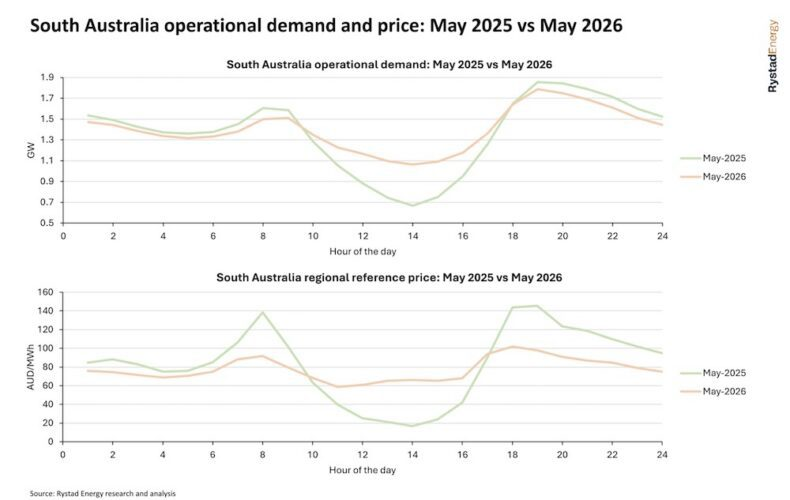
That is showing up in prices too – with batteries helping to flatten the notorious 'duck curve' by shifting the supply of cheap solar power to mornings and evenings when demand is highest. While the demand profile hasn't changed much from 2025 to 2026 (see the upper chart below), the prices Australians are paying at peak times are significantly lower (see the flattened orange line in the lower chart below).
Lest we rely too heavily, however, on faith that the transition to renewables is inevitable, the chart below (from JP Morgan) is a chastening reminder that bad policy can certainly create obstacles in the near-term.
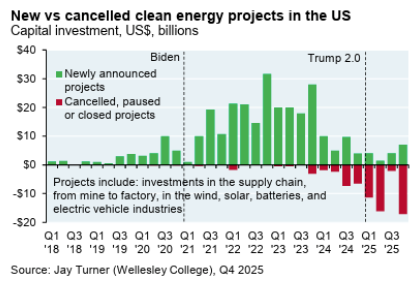
The Trump administration's aggressive obstructionism has substantially reversed the momentum for clean tech that was growing during the Biden presidency, and even during Trump 1.0. This might well be temporary, but it is still regressive.
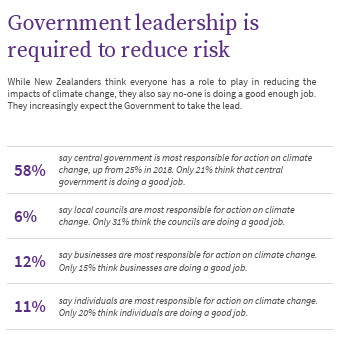
Finally, with an eye to the forthcoming election, it was interesting to read IAG's 2026 Ipsos survey of New Zealanders’ attitudes and expectations toward the impacts of climate change. Contrary to the elite talking point that 'the public' has lost interest in climate change, 92% of respondents expect to see more frequent and extreme floods; and 63% expect to be affected by the impacts of climate-related hazards.
It was also striking where people placed responsibility for climate action. Well over half (58%) said central government had primary responsibility, and only 21% believed it is doing a good job.
It is sometimes claimed that climate change doesn't matter for elections, but the 2022 general election of Australia is an obvious counterpoint. PM Scott Morrison's disconnectedness during the 2019–2020 fire season and the 2022 eastern Australian floods contributed to his unpopularity with voters, and a swing toward centrist 'teal independents' in inner-city electorates.
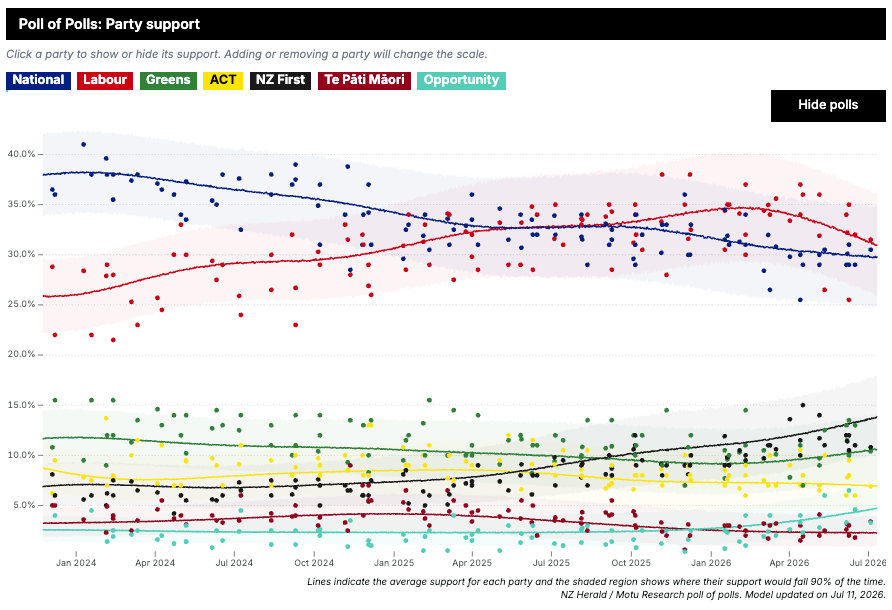
In Aotearoa New Zealand, it is the Opportunity Party (TOP) which has most determinedly gone after the teal vote, hoping to peel off disillusioned voters from the liberal side of the National Party. So it is interesting to see TOP at the critical 5% threshold and still gaining momentum, according to the NZ Herald / Motu Research poll of polls (below). In a proportional representation system like ours, that significantly widens the coalitional dynamics.
Thanks for reading this far! If you haven't already, please subscribe to receive future content like this, as well as essays and transition-related briefings.