

New Zealand’s 2026 general election is being described as weird and bizarre.
But that’s from the parochial perspective of New Zealand’s previous elections. From a wide-angle perspective across the world’s liberal democracies, New Zealand’s election is on-trend, albeit playing out in uniquely Kiwi ways.
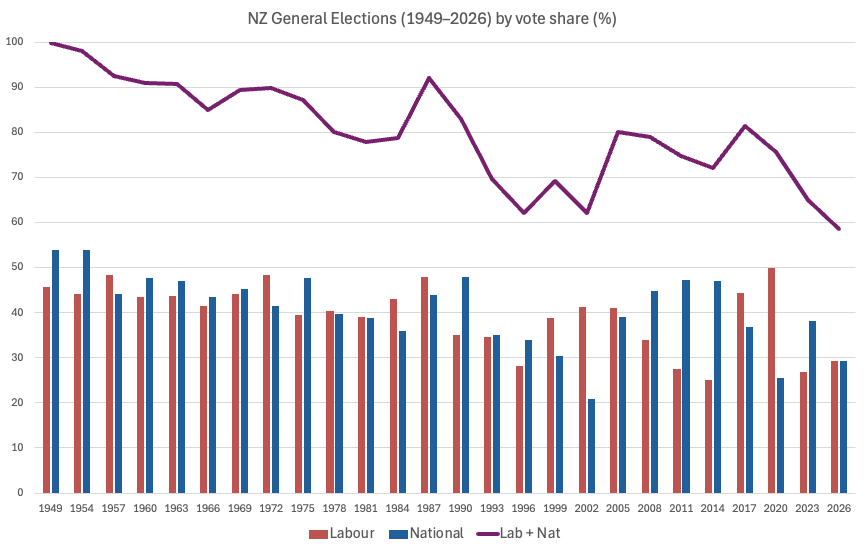
We live in an era of popular frustration and cynicism toward political elites. In democratic systems, this is largely directed toward the legacy parties in the political centre. It is their decisions over previous decades that created, or permitted, the economic circumstances of today, which is disenfranchising ever more voters. It is also the centre parties that respond too often with guarded, directionless and overly managed rhetoric that betrays a sense of detachment and carelessness toward material issues.
In the great political duopolies—the UK and the US—this political disaffection has largely played out as instability within the major parties. The UK, for instance, has cycled through seven prime ministers since 2016. In the US, the Republican Party was hastily transformed from a neocon fortress to a Trumpist personality cult. The electoral systems in these countries, which are versions of first-past-the-post (FPP), afford the major parties a structural persistence. Consequently, political diversity and change must largely be fought out among factions within the big-tent parties.
But the electoral system in Aotearoa New Zealand is a type of proportional representation, known as mixed-member proportional (MMP), which is far more enabling for minority parties. In this milieu of political discontent, it has fallen to the minority parties—which are freer from the historical culpability for the status quo—to bring ambition, innovation and political creativity into parliament. If it was not for them, political diversity would be largely confined to the ideological wings of the National and Labour parties, whose leaders and managers would set the pace of change. Through the minority parties, however, voters can express their frustrations more directly—in something closer to their own voice—and potentially bring forward the policy solutions that the incumbent parties will not.
There is a tendency to overplay the significance of elections. Each election determines the make-up of parliament, but each parliament exists within a confluence of political currents that shapes what it can achieve. Often, it is these deeper currents that create history, rather than the temporary agency that an election bestows upon a government.
The backlash against the political establishment is one such current, a mega-trend in the parlance of fancy analysts. And the minority parties each manifest a different form of this – from the high moralism of the Greens, to the reactionary rangatiratanga of Te Pāti Māori, to the technocracy-lite of The Opportunity Party, to New Zealand First’s radicalism of the centre (to echo Seymour Martin Lipset), to the shocking-pink populist libertarianism of ACT.
The prominence of these parties has provoked centrist politicians and other commentators to bemoan MMP for growing tails that wag the dog. In turn, this has given flight to nostalgia for FPP, or envy of more exotic electoral arrangements. Yet, when evaluating our electoral system, it is too self-centred to start with the question: am I satisfied with the outcome of this particular election? The more pertinent question is: am I satisfied with how this electoral system has performed under these particular circumstances?
The power now afforded to minority parties is simply the system working as intended. 41.43% of voters gave their support to minority parties, which is more or less reflected in the allocation of seats. This gives a fair hearing to the anti-establishment energies that are rising today, and within the disciplining effect of parliament. This is why countries like the UK are seriously entertaining proportional representation to ease the tensions created by managing a two-party system in a multi-party age.


This isn’t to say that there aren’t reasonable concerns about MMP in its current configuration. One much discussed concern is that the decline in centre parties has increased the likelihood of an overhang, which, in turn, may undermine the proportionality in parliament. At the time of writing, before special votes are counted, the National Party won 29.21% of the party vote but holds 32% of the seats (42 of 131 seats). The Labour Party, by contrast, won 29.36% of the party vote, but holds 27.5% of the seats (36 of 131 seats). This lack of proportionality is precisely the issue that MMP set out to solve, so it makes sense to address this well-defined problem by future reforms.
 Jack Vowles
But if the centre parties want to restore their preeminence, they need to work at it. Not through electoral reform, but through the basic arts of politics: telling unifying narratives, being authentic and responsive, building policy capability and party networks, exercising good judgement and political courage, and recovering the virtues of what once was called ‘statesmanship’.
What’s so aggravating about the tail-wags-the-dog critique of MMP is that it’s another excuse for centre parties to do nothing, a way to divert blame onto the electoral system, and to abdicate the responsibility for remaining politically competitive. It distracts the centre parties from confronting the system of mediocre capitalism that they stewarded over the past few decades, which is both suppressing the economic dynamism desired by the political right, and intensifying the social and environmental externalities despised by the left.
Until the centre parties can credibly reckon with why middling voters are increasingly disaffected, those voters will look elsewhere for solutions to their problems. MMP facilitates this trend, but its drivers lie elsewhere.
 Ainsley Thomson
Thanks for reading this far! If you haven't already, please subscribe to receive future essays like this, as well as other updates and transition-related briefings.