

In this week's edition of The Pointillist, a collection of data points on the acceleration of energy transitions since the closure of the Strait of Hormuz – from changing narratives on energy security, to war-related emissions, to historical shocks, to demand destruction, to the unequal spoils of fossil profits.


Join me with esteemed writer Amitav Ghosh (Nutmeg's Curse, Great Derangement) and novelist Charlotte McConaghy at the Auckland Writers Festival on 17 May 2026.
The near future in two charts (see below).
The IEA 'base case' scenario assumes that oil shipments will gradually resume from May, allowing a swift recovery of oil supply.
But, in reality, negotiations are floundering and conflict is re-igniting, with Iran only yesterday striking an energy installation in Fujairah, UAE.
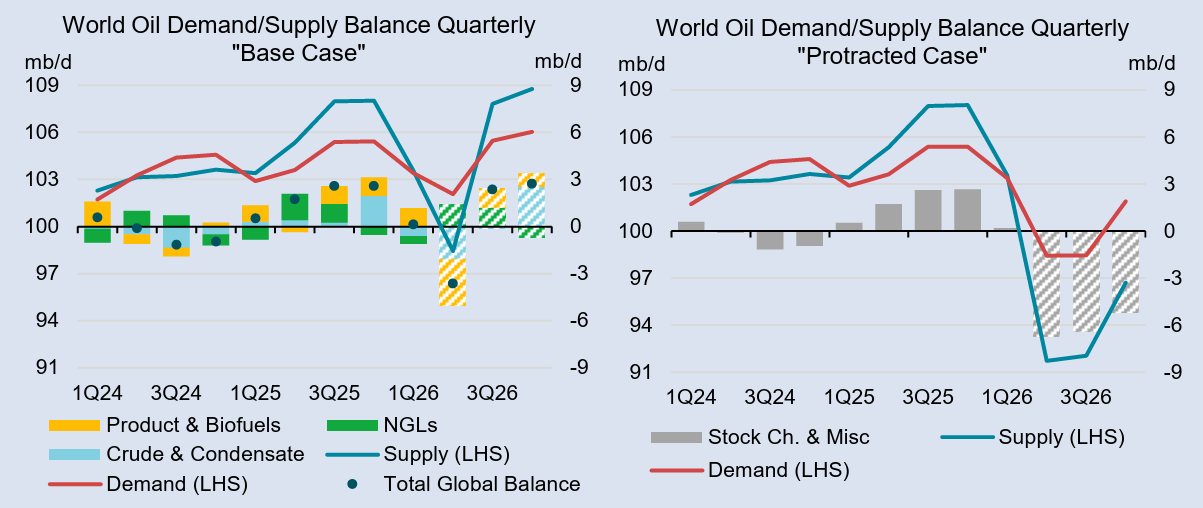
That makes the 'protracted case' ever more probable, where supply shortfalls of about 6 million barrels a day are stretched across the year, with an elongated recovery. As the IEA drily puts it: 'further deliberate demand reduction efforts will rapidly be required to balance the market and avoid even deeper economic damage.'
These events are prompting a monumental reframe of energy security.
Here is Simon Stiell, the UN Climate Change Executive Secretary, speaking in Paris on 30 April 2026:
... an immense irony is unfolding. Those who’ve fought to keep the world hooked on fossil fuels are inadvertently supercharging the global renewables boom.
Renewables offer safer, cheaper, cleaner energy that can’t be held captive by narrow shipping straits, or global conflicts... That’s why so many governments are pushing renewables plans into overdrive: to restore national security, economic stability, competitiveness, policy autonomy and basic sovereignty.
Now it's fossil fuels that are undependable, fickle and intermittent. Renewables are seizing the mantles of security and affordability.
Do not underestimate the power of this paradigm shift.
See also Tej Parikh in The Financial Times:
Trump’s capricious approach to foreign policy and trade has provided a fillip to the global energy transition. For years, the shift to greener sources has been overly reliant on subsidies and moralising over climate change. Now, policymakers and energy consumers see it more as a matter of cost, security and abundance. That could make it far more enduring.
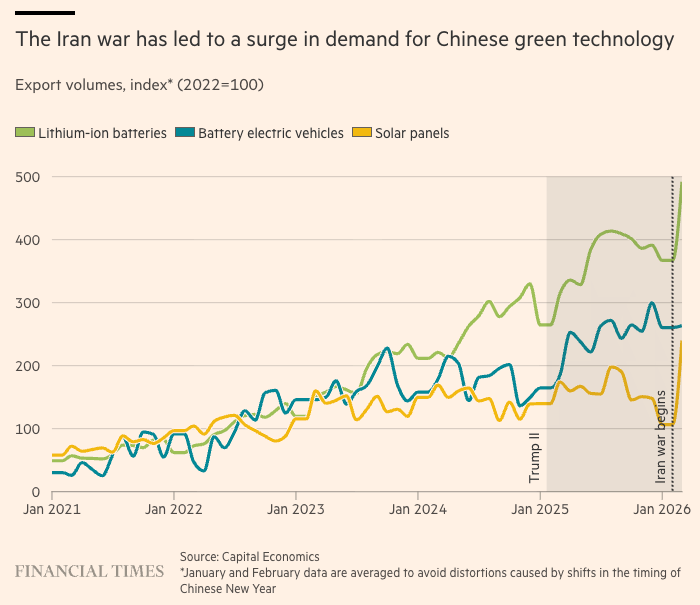
As he argues, this has profound implications for geopolitics, tied up as they are in the global supply of new energy technologies. China is the prime beneficiary of American folly.
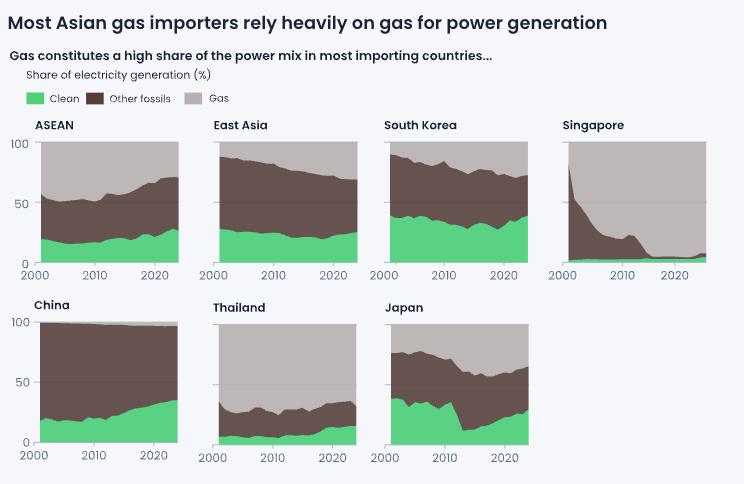
Asia is particularly exposed to the looming price shock, as this Ember briefing shows. Singapore's reliance on fossil gas for electricity generation is alarming, Thailand's hardly less so.
New Zealand enters the picture with this brilliant chart from Prageeth Jayathissa, Vector's GM of Sustainability. It shows wholesale electricity prices from selected countries – with added explanations on price drivers.
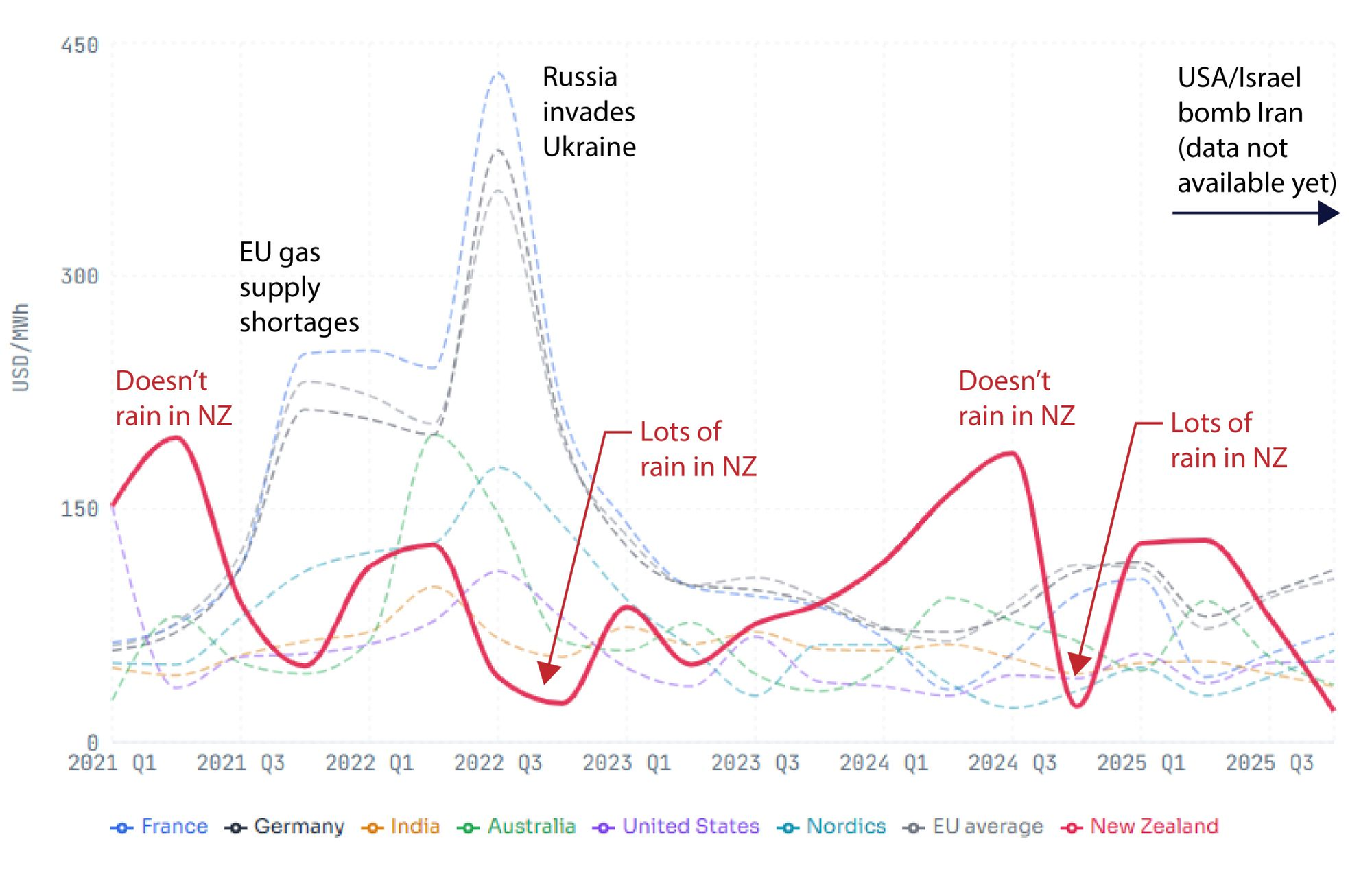
Like Southeast Asia, the EU is highly dependent on fossil gas for electricity generation, exposing it to geopolitical shocks.
New Zealand, by contrast, is insulated from the volatility of global gas markets. Rather, rainfall is the defining factor in wholesale electricity prices.
Obviously we could do better to smooth out this susceptibility to climatic variability. But why would we do that – as the New Zealand Government is currently contemplating – by subsidising an LNG import terminal that increases our exposure to global price shocks? Unless you are blind to such risks – which, to be fair, the government's economic assessments appear to be (see the RNZ story below) – it makes far more sense to invest in onshore solutions like renewables build-out, demand management and pumped hydro.
 Kate Newton
New Zealanders are starting to adapt to elevated fuel prices – but I am certain this is only the beginning.
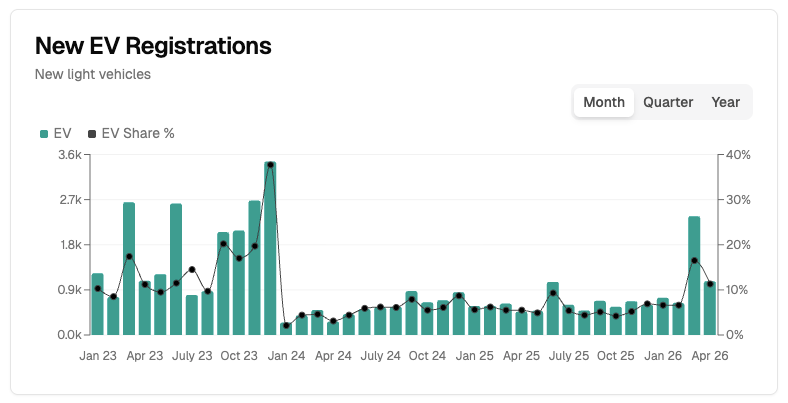
New EV registrations spiked in March 2026, reaching levels unseen since the Clean Car Discount was active (see the chart from EVDB below). Numbers have dropped back since, but this is likely due to supply constraints rather than lack of demand.
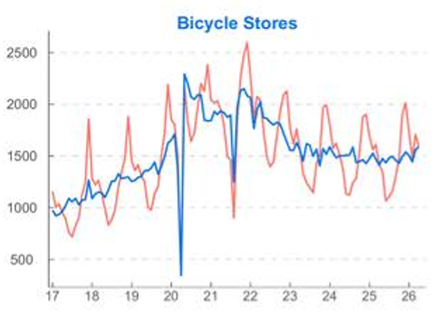
New Zealanders are also shifting to alternative forms of transport. According to new data from ANZ Research, card spending on bicycles is trending upward, an increase of 1.9% in the last month, after an extended decline over recent years.
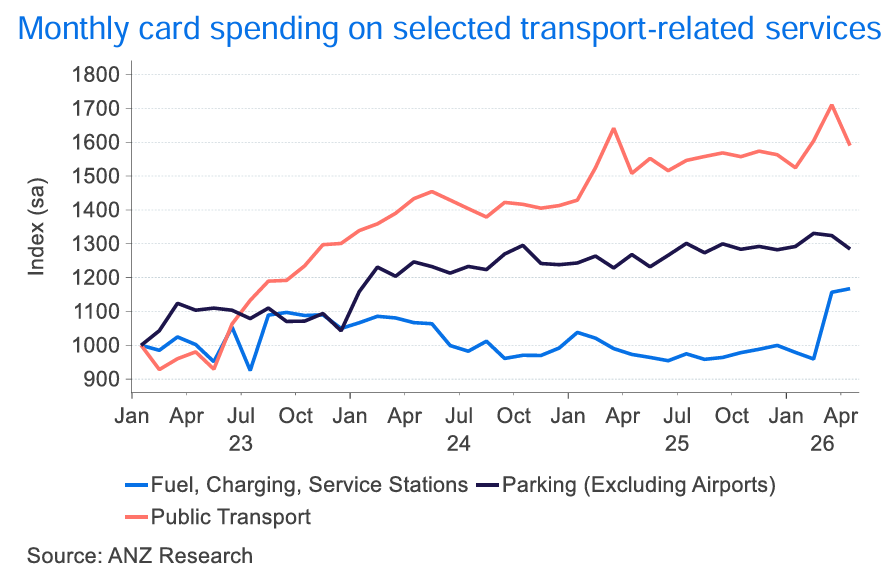
Curiously, public transport spending fell by 7% in April, after steep gains in March. The broader trend is still upward, however, an increase of 5.7% year-on-year.
Of course, we should not wish to induce energy transitions by way of war. The violence and fear for so many in the Middle East is appalling. Further lives are likely to be lost around the world by food and fuel shortages in coming months.
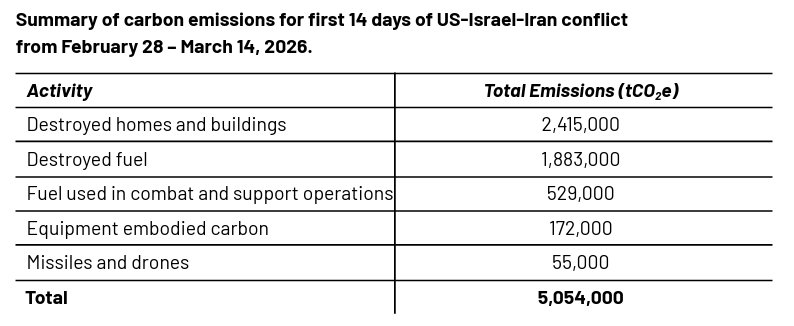
War is also a highly emissions-intensive activity. The Climate and Community Institute estimated that, in the first two weeks of the Israel-US-Iran conflict – which remains its most destructive phase so far – more than 5 million tonnes of carbon dioxide equivalents (CO2e) were emitted into the atmosphere. For perspective, that's more than the annual emissions of Iceland (4.3m t/CO2e).
Disorderly transitions are also prone to uneven impacts, heightening the economic inequalities that feed into political instability.
It is worth recalling this 2025 paper (which I cited in The Pointillist #5) by Gregor Semieniuk, Isabella Weber, Jean-Francois Mercure and others. They tracked the flow of US fossil fuel profits during the 2021–2022 spike in oil and gas prices. Half of all profit claims were held by the top 1% of wealth owners, and 84% by the top 10%. By contrast, the bottom half of the population (66 million American households) received hardly any profits at all: only 1%.

This is bound to be repeated as US oil and gas majors rush to fill the gap in global supply. As Bloomberg reports, the US is already exporting record levels of oil, up over 6 million barrels per day, to compensate for the global shortfall. This deepens the US's relatively new status as a major global supplier of oil. Prior to 2014, the US barely exported any oil at all, with its exports only exceeding its imports in about 2020.
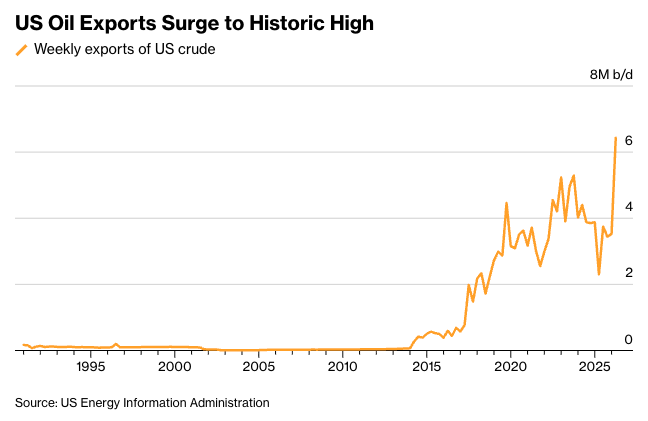
These higher outflows are cutting into domestic stockpiles of crude and oil products, which in turn influences prices. In the US, diesel has nearly doubled in price to over USD$4 per gallon. Gasoline has increased by over 40% to USD$4.50 per gallon.
So, whatever economic gains that Trump claims off the back of the Israel-US-Iran conflict, most will be absorbed by the wealthiest Americans, while ordinary Americans will suffer higher food and energy prices. Little wonder that Trump's approval ratings are cratering.
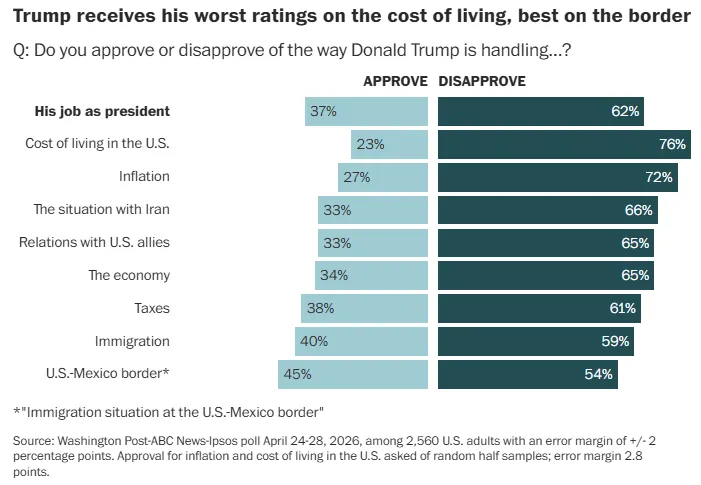
The US mid-terms close on 3rd November, only four days before New Zealand's general election. The tone of the former cannot help but rub off on the latter, as New Zealanders wrestle with the material consequences of MAGA hubris.
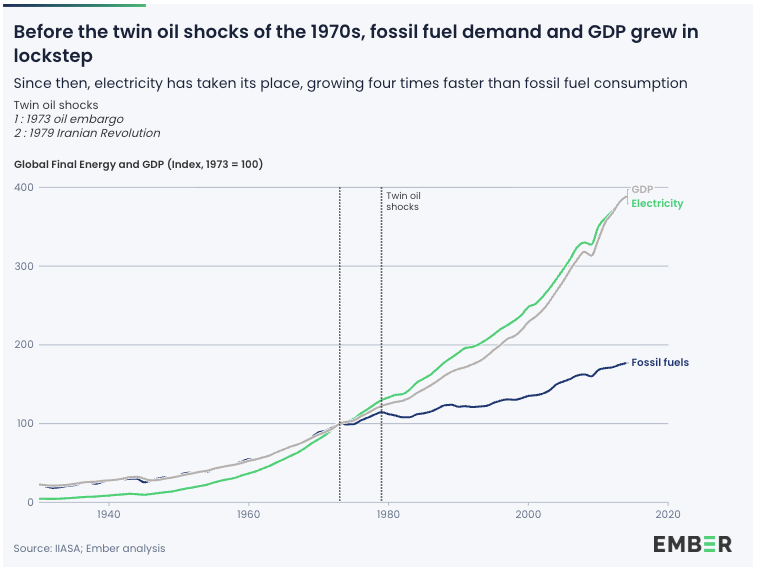
While shock-induced transitions are tragic, they are also historically and structurally significant. This Ember explainer describes how the 1970s oil shocks resulted in a permanent weakening of fossil fuel dependence.
Up until the 1970s, fossil fuel consumption and GDP grew in lockstep (see below). But after the oil shocks, GDP hitched a ride instead with electricity consumption, resulting in a relative decoupling from fossil fuels.
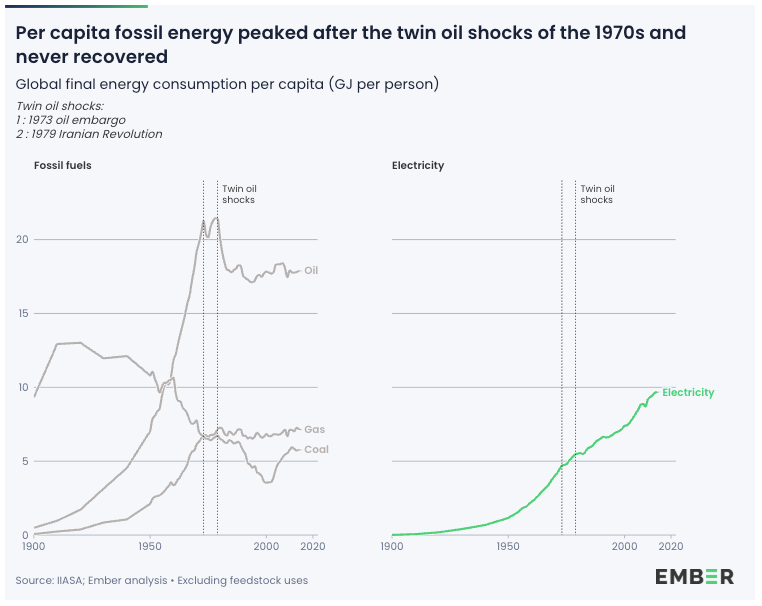
Similarly, global per capita rates of oil and gas consumption were permanently affected by the oil shocks (see below). Oil and gas consumption has flatlined since, partly due to efficiency gains, but also due to transitions to alternatives, including nuclear and increasingly renewables.
What makes this shock different – a rhyme in history rather than a repeat – is the availability of technological alternatives:
The 1970s reshaped the energy system despite alternatives that were slow, expensive and addressed only a fraction of fossil demand. Today’s are faster, cheaper, fuel-free and able to replace most of it. For the first time, superior low-cost alternatives exist at scale. The question is whether governments build forward to the electric age or reach back to patch up the fossil one.
As I ponder this moment, I can't get past the mental image of Wile E. Coyote and his notorious fall.

What makes it so agonizing is the gap between one's fate being sealed and being delivered.
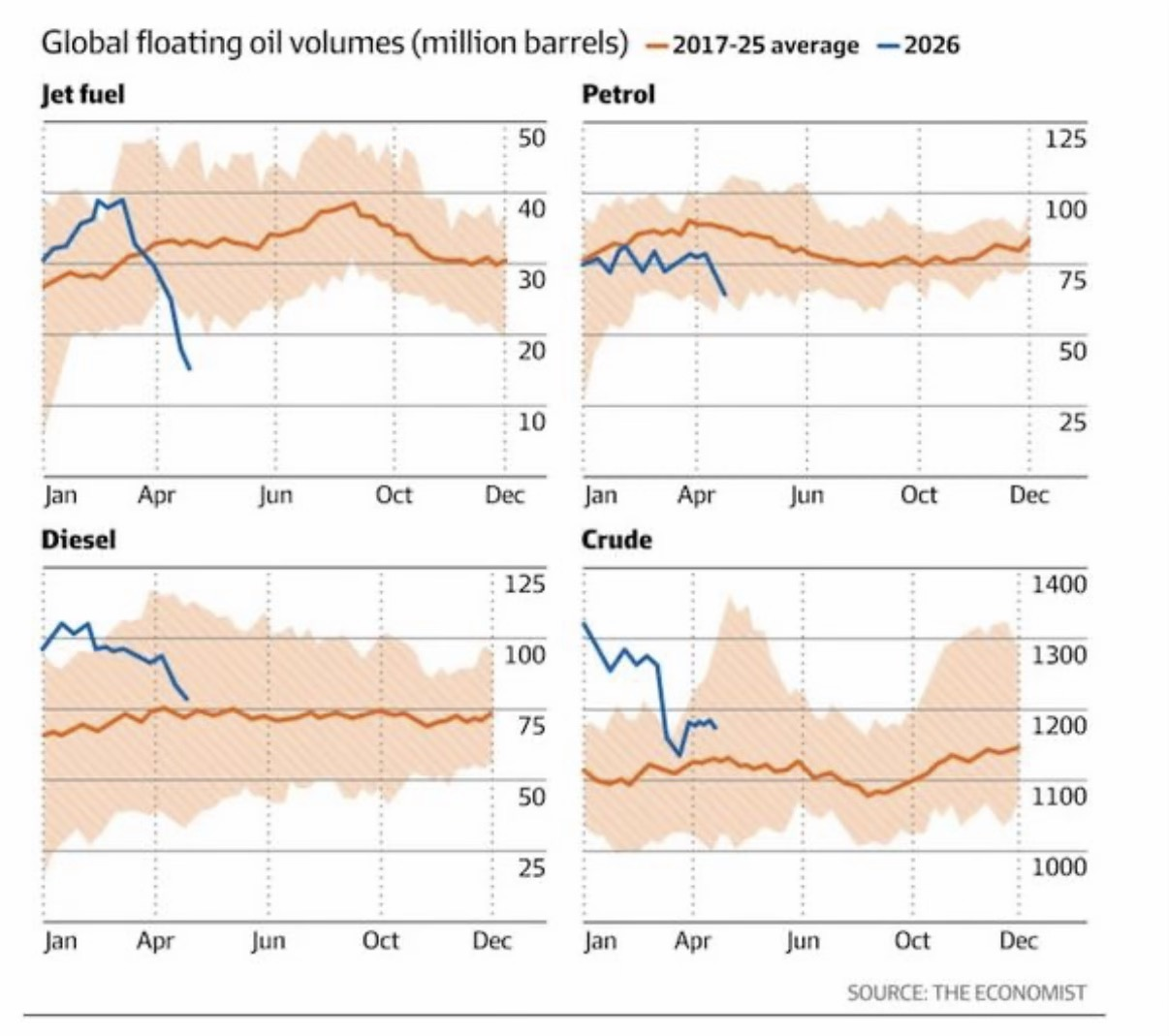
That dizzying moment – over the ledge but stubbornly aloft – is where the global economy is today as it depletes the buffers in the fossil energy system. You can see it in the chart below of global floating oil volumes – that is, the fuel stocks currently on the water. Those steep declines are revealing the clear air beneath our feet, the gap in supply which will soon come up to hit us in the face.
It is almost certainly too late to prevent the fall, but might we at least learn not to put ourselves in such a precarious position?
Finally, if you want to dig deeper into the geopolitics of the unruly energy transition on our horizon, I recommend the new podcast series, Demand Destruction, by Kate Mackenzie and Tim Sahay. Their previous podcast, Electric World Order, is also good fun.
 Kate Mackenzie
Thanks for reading this far! If you haven't already, please subscribe to receive future content like this, as well as essays and transition-related briefings.